Polymers of intrinsic microporosity (PIMs)
|
![]() |
||
|
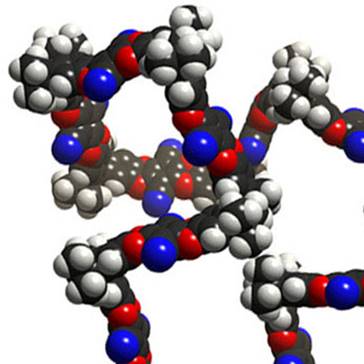
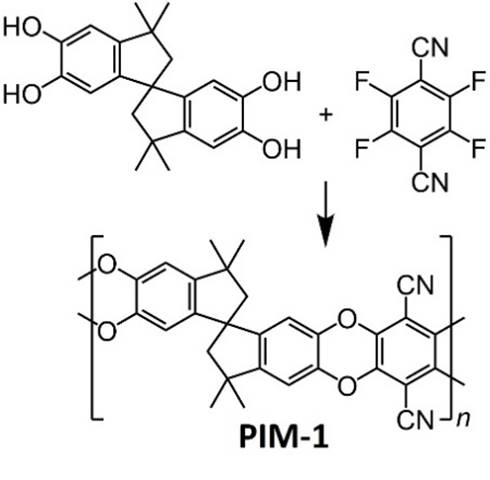
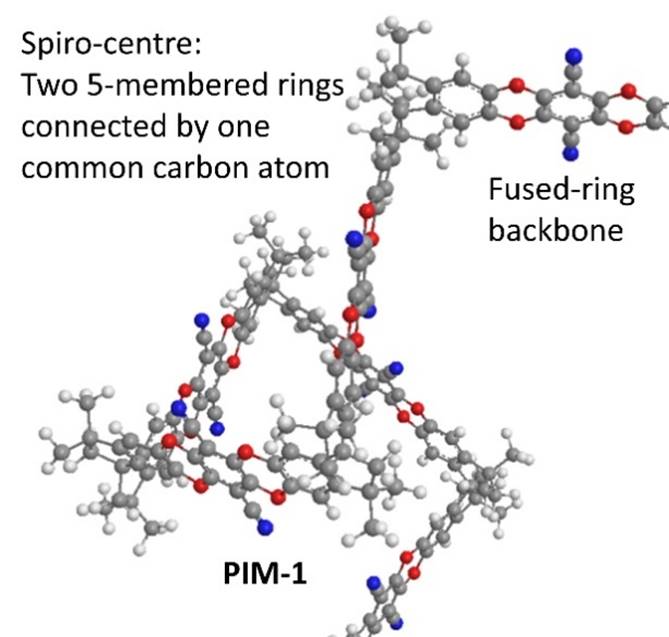
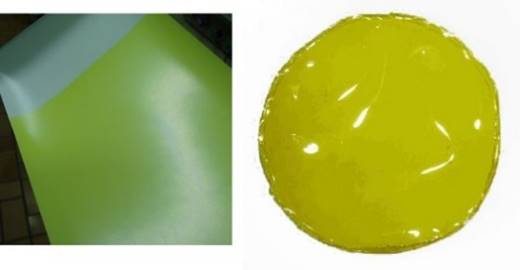
Polymers of intrinsic microporosity (PIMs) are polymers which behave like molecular sieves in the solid state, because they have rigid, contorted molecular structures that are unable to pack efficiently. We are developing both insoluble network materials and soluble PIMs that may be precipitated from solution as powders or cast into a membrane form. One example of a network PIM incorporates phthalocyanine units and allows access to catalytically active transition metal ions within the central cavity of the macrocycle. In contrast, the catalytic activity of a precipitated low molar mass phthalocyanine is limited because of the tendency for the macrocycles to associate. Two examples of soluble PIMs are PIM-1 and PIM-7. These polymers have no single bonds in the backbone about which rotation can occur, but they incorporate spiro-centres that introduce sharp bends into the chain. In the solid-state they exhibit high apparent surface areas by nitrogen sorption (700-900 square metres per gram). They are amorphous and remain glassy up to their decomposition temperatures (>350 ºC). In membrane form, they perform extremely well for gas separations such as oxygen/nitrogen. In powder form, they act as selective sorbents, e.g. for the removal of phenolic compounds from aqueous media. The phenazine unit in PIM-7 can act as a ligand for the coordination of metal ions, giving rise to catalytically active materials.
SELECTED PUBLICATIONS A.G. McDermott, G.S. Larsen, P.M. Budd, C.M. Colina and J. Runt, Structural characterization of a polymer of intrinsic microporosity: X-ray scattering with interpretation enhanced by molecular dynamics simulations, Macromolecules, ONLINE. DOI: 10.1021/ma1024945 N.B. McKeown and P.M. Budd, Exploitation of intrinsic microporosity in polymer-based materials, Macromolecules, 2010, 43, 5163-5176. DOI: 10.1021/ma1006396 T. Emmler, K. Heinrich, D. Fritsch, P.M. Budd, N. Chaukura, D. Ehlers, K. Raetzke and F. Faupel, Free volume investigation of polymers of intrinsic microporosity (PIMs): PIM-1 and PIM1 copolymers incorporating ethanoanthracene units, Macromolecules, 2010, 43, 6075-6084. DOI: 10.1021/ma1008786 B.S. Ghanem, M. Hashem, K.D.M. Harris, K.J. Msayib, M. Xu, P.M. Budd, N. Chaukura, D. Book, S. Tedds, A. Walton and N.B. McKeown, Triptycene-based polymers of intrinsic microporosity: organic materials that can be tailored for gas adsorption, Macromolecules, 2010, 43, 5287-5294. DOI: 10.1021/ma100640m B.S. Ghanem, N.B. McKeown, P.M. Budd, N.M. Al-Harbi, D. Fritsch, K. Heinrich, L. Starannikova, A. Tokarev and Y. Yampolskii, Synthesis, characterization, and gas permeation properties of a novel group of polymers: PIM-polyimides, Macromolecules, 2009, 42, 7881-7888. DOI: 10.1021/ma901430q P.M. Budd, N.B. McKeown, B.S. Ghanem, K.J. Msayib, D. Fritsch, L. Starannikova, N. Belov, O. Sanfirova, Y. Yampolskii and V. Shantarovich, Gas permeation parameters and other physicochemical properties of a polymer of intrinsic microporosity: Polybenzodioxane PIM-1, J. Membr. Sci., 2008, 325, 851-860. DOI: 10.1016/j.memsci.2008.09.010 M. Carta, K.J. Msayib, P.M. Budd and N.B. McKeown, Novel spirobisindanes for use as precursors to polymers of intrinsic microporosity, Org. Lett., 2008, 10, 2641-2643. DOI: 10.1021/ol800573m B.S. Ghanem, N.B. McKeown, P.M. Budd, J.D. Selbie and D. Fritsch, High performance membranes from polyimides with intrinsic microporosity, Adv. Mater., 2008, 20, 2766-2771. DOI: 10.1002/adma.200702400 M. Heuchel, D. Fritsch, P.M. Budd, N.B. McKeown and D. Hofmann, Atomistic packing model and free volume distribution of a polymer with intrinsic microporosity (PIM-1), J. Membr. Sci., 2008, 318, 84-99. DOI: 10.1016/j.memsci.2008.02.038 N.B. McKeown, P.M. Budd and D. Book, Microporous polymers as potential hydrogen storage materials, Macromol. Rapid Commun., 2007, 28, 995-1002. P.M. Budd, A. Butler, J. Selbie, K. Mahmood, N.B. McKeown, B. Ghanem, K. Msayib, D. Book and A. Walton, The potential of organic polymer-based hydrogen storage materials, Phys. Chem. Chem. Phys., 2007, 9, 1802-1808 B. Ghanem, N.B. McKeown, K.D.M. Harris, Z. Pan, P.M. Budd, A. Butler, J. Selbie, D. Book and A. Walton, A triptycene-based polymer of intrinsic microporosity that displays enhanced surface area and hydrogen adsorption, Chem. Commun., 2007, 67-69. N.B. McKeown and P.M. Budd, Polymers of intrinsic microporosity (PIMs): organic materials for membrane separations, heterogeneous catalysis and hydrogen storage, Chem. Soc. Rev., 2006, 35, 675-683. A. V. Maffei, P. M. Budd and N. B. McKeown, Adsorption studies of a microporous phthalocyanine network polymer, Langmuir, 2006, 22, 4225-4229. N. B. McKeown, B. Ghanem, K. J. Msayib, P. M. Budd, C. E. Tattershall, K. Mahmood, S. Tan , D. Book, H. W. Langmi and A. Walton, Towards polymer-based hydrogen storage materials: engineering ultramicroporous cavities within polymers of intrinsic microporosity, Angew. Chem. Int. Ed., 2006, 45, 1804-1807. P.M. Budd, N.B. McKeown and D. Fritsch, Free volume and intrinsic microporosity in polymers, J. Mater. Chem., 2005, 15, 1977-1986 N.B. McKeown, P.M. Budd, K.J. Msayib, B.S. Ghanem, H. Kingston, C.E. Tattershall, S. Makhseed, K.J. Reynolds and D. Fritsch, Polymers of Intrinsic Microporosity (PIMs): Bridging the void between microporous and polymeric materials, Chem. Eur. J., 2005, 11, 2619-2620 P.M. Budd, K.J. Msayib, C.E. Tattershall, B.S. Ghanem, K.J. Reynolds, N.B. McKeown and D. Fritsch, Gas separation membranes from polymers of intrinsic microporosity, J. Membr. Sci., 2005, 251, 263-269. P.M. Budd, S.M. Makhseed, B.S. Ghanem, K.J. Msayib, C.E. Tattershall and N.B. McKeown, Microporous polymeric materials, Materials Today, April 2004, p 40-46. P.M. Budd, E.S. Elabas, B.S. Ghanem, S. Makhseed, N.B. McKeown, K.J. Msayib, C.E. Tattershall and D. Wang, Solution-processed, organophilic membrane derived from a polymer of intrinsic microporosity , Adv. Mater., 2004, 16, 456-459. P.M. Budd, B.S. Ghanem, S. Makhseed, N.B. McKeown, K.J. Msayib and C.E. Tattershall, Polymers of intrinsic microporosity (PIMs): robust, solution-processable, organic nanoporous materials, Chem. Commun., 2004, 230-231. P.M. Budd, B. Ghanem, K. Msayib, N.B. McKeown and C. Tattershall, A nanoporous network polymer derived from hexaazatrinaphthylene with potential as an adsorbent and catalyst support, J. Mater. Chem., 2003, 13, 2721-2726. N.B. McKeown, S. Hanif, K. Msayib, C.E. Tattershall and P.M. Budd, Porphyrin-based nanoporous network polymers, Chem. Commun., 2002, 2782-2783. N.B. McKeown, S. Makhseed and P.M. Budd, Phthalocyanine-based nanoporous network polymers, Chem. Commun., 2002, 2780-2781.
|
Molecular model of a nanoporous network incorporating phthalocyanine units.
(a) PIM-1; (b) PIM-7; (c) Molecular model of PIM-1 fragment showing its rigid, contorted structure.
|